
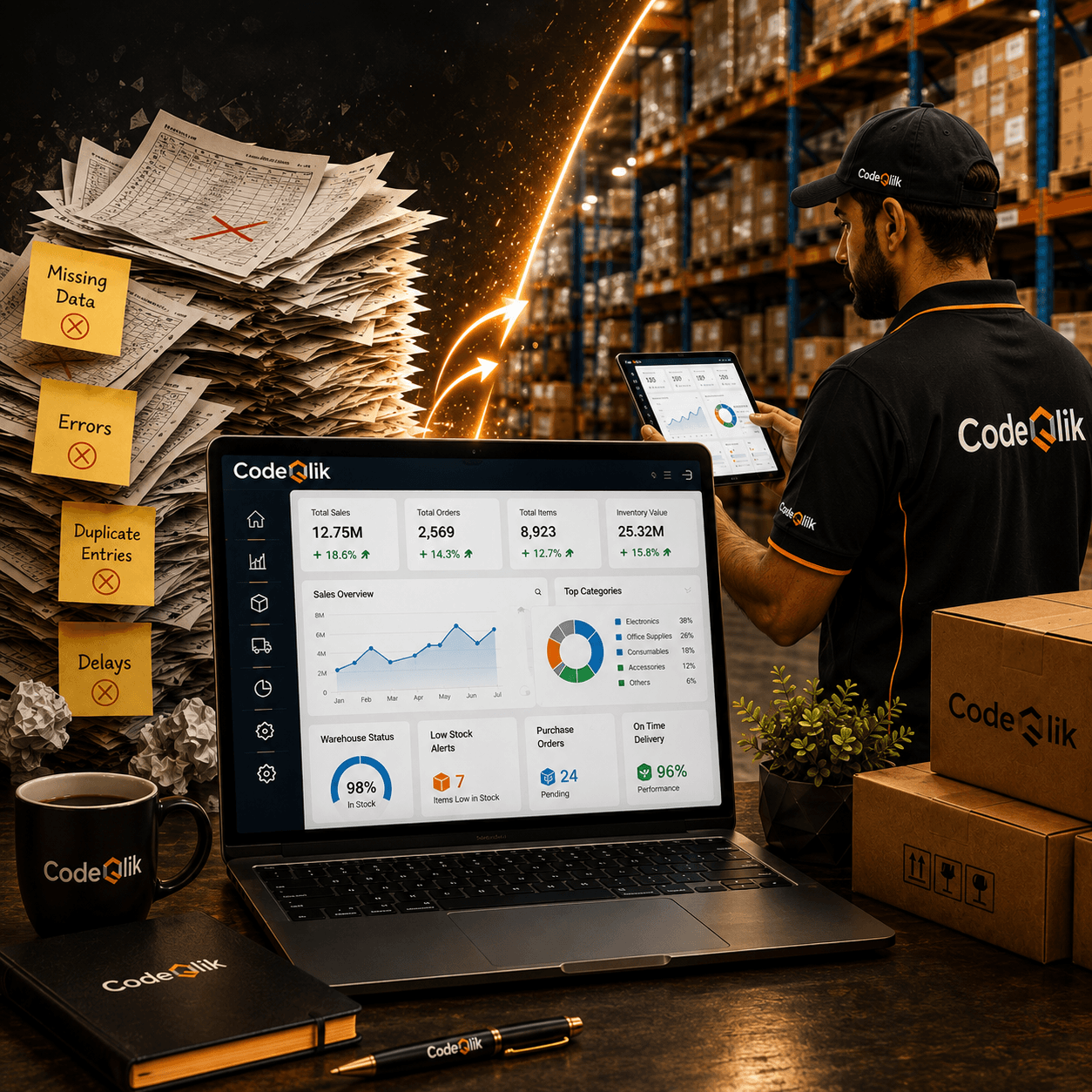
What "Moving From Spreadsheets to ERP" Actually Means
Before going further, it's worth being precise about the terms, since they get thrown around loosely.
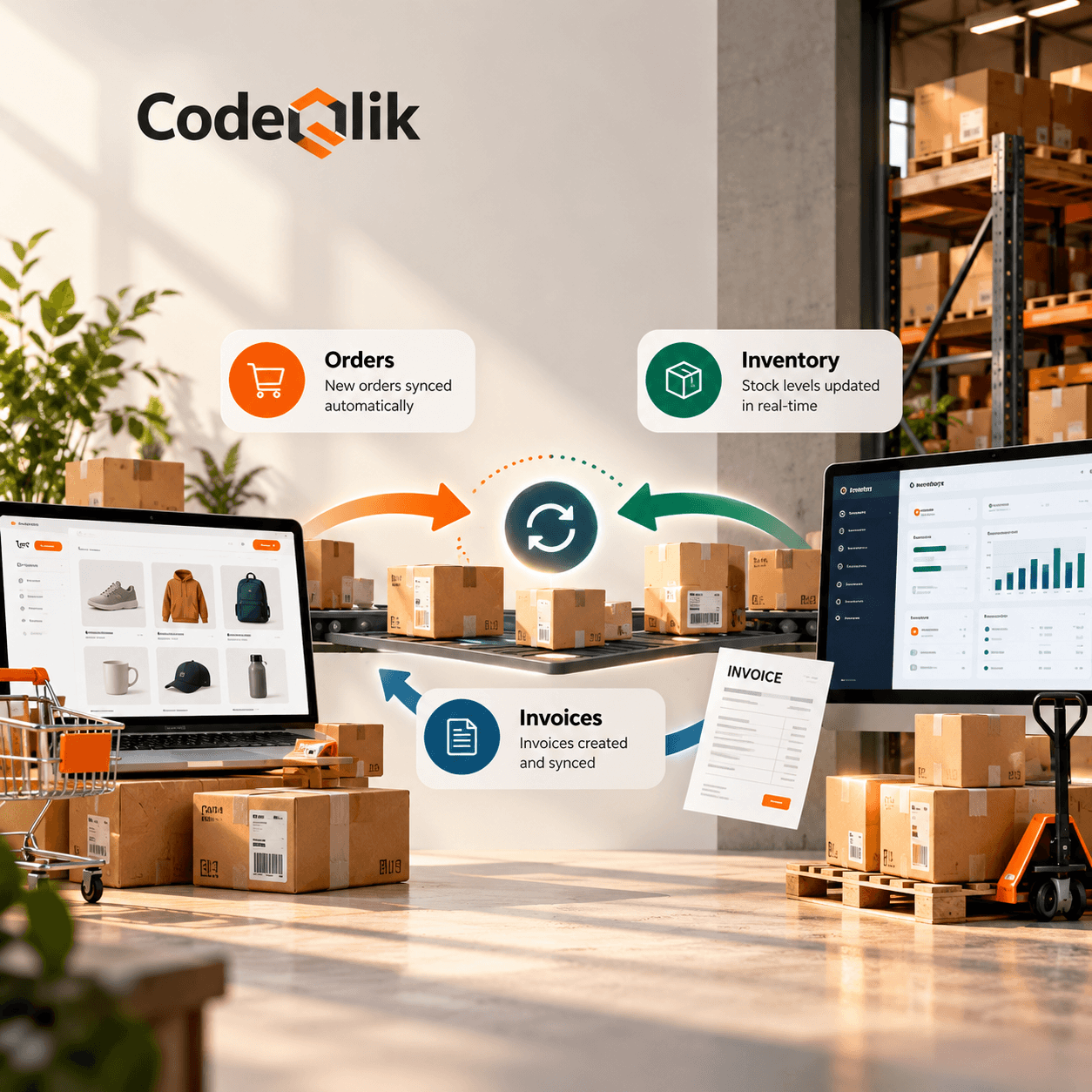
ERP (Enterprise Resource Planning) is a single software system that connects the different functions of a business — finance, inventory, sales, HR, procurement, and often production — into one shared database. Instead of a sales team working off one spreadsheet, warehouse staff off another, and accounting off a third (each updated on a different schedule, by a different person, with different assumptions), everyone works from the same live information.
Spreadsheets, by contrast, are single-user tools stretched to do a multi-user job. Excel is genuinely excellent at what it was built for: quick calculations, one-off analysis, personal budgeting. It was never built to be a company's inventory system, its accounting ledger, and its HR database at the same time — yet that's exactly how many Saudi SMEs have been using it, often out of necessity during the early growth years.
The move to ERP, then, isn't really about a "software upgrade." It's about replacing dozens of disconnected files, each representing someone's individual effort, with one connected source of truth that the whole business can rely on.
The Market Signal: Saudi ERP Adoption Is Accelerating
The numbers back up what business owners are seeing on the ground. Industry research from Dimension Market Research puts the Saudi ERP software market at roughly USD 492.8 million in 2026, projecting growth at a compound annual rate of over 15% through 2035 — positioning the Kingdom as one of the fastest-growing ERP markets in the Middle East and Africa region.
A few things stand out in how that growth is distributed:
- Construction and real estate is the fastest-growing vertical for ERP adoption, reflecting the Kingdom's giga-project pipeline and the pressure on contractors to deliver auditable project cost data.
- Manufacturing leads by overall adoption share, echoing Vision 2030's industrial localization goals.
- Small enterprises already represent a meaningful and fast-growing share of adoption — this is no longer just a large-enterprise story.
- Cloud ERP is leading new deployments, which matters for SMEs that don't want to run their own servers or hire an in-house IT team just to keep software running.
None of this happened by accident. Three forces, largely unique to the current Saudi business environment, are pushing companies off spreadsheets faster than in most other markets.
Why Saudi SMBs Are Making the Switch Now
1. ZATCA E-Invoicing Compliance Has Made Spreadsheets a Liability
This is probably the single biggest accelerant for ERP in Saudi Arabia in 2026. E-invoicing regulations require businesses to generate, exchange, clear or report, and store invoices in a structured electronic format through a compliant system — paper invoices and PDFs generated outside that system no longer satisfy the requirement.
The rollout has moved in stages by company turnover, and the net is tightening fast. The most recent wave lowers the integration threshold to businesses with turnover above SAR 375,000, with an integration deadline of 30 June 2026 — effectively making integrated e-invoicing universal for small and mid-size businesses. After that date, ZATCA's penalty-waiver initiative for correcting past errors expires permanently, and the authority shifts from an educational posture to full enforcement.
In practical terms: a business invoicing customers out of Excel or a basic accounting tool simply cannot comply. Invoices need to be structured XML files with an embedded cryptographic stamp, a digital signature, a unique invoice ID, and a QR code, integrated in real time with ZATCA's Fatoora platform. That's not a spreadsheet macro — it's a systems integration challenge, and it's one of the clearest, most concrete reasons Saudi finance teams are finally getting budget approval for ERP.
2. Spreadsheets Break Down Exactly When Growth Speeds Up
Spreadsheets scale linearly with effort, but businesses don't grow linearly. A company that doubles its order volume doesn't just need someone to type twice as fast — it needs its inventory, sales, and finance data to reconcile automatically, in real time, across departments and often across cities.
This is where the classic spreadsheet failure modes show up, and Saudi business owners describe the same handful of pain points again and again:
- Version chaos. Multiple copies of the same file, emailed back and forth, with no reliable way to know which one is current.
- No real-time visibility. A retailer in Riyadh can't see live stock levels in a Jeddah warehouse without someone manually updating a file — by which point the numbers may already be wrong.
- Manual errors that compound. A single mistyped formula or dragged cell reference can silently distort a budget, a payroll run, or a customer invoice.
- No audit trail. When a number changes, spreadsheets rarely show who changed it, when, or why — a serious weakness for zakat and tax reporting, board reporting, or investor due diligence.
- Zero scalability across teams. Spreadsheets work reasonably well for one person or a small team. They fall apart the moment ten people in five departments need to work from the same information at the same time.
None of this is a knock on the people using spreadsheets — it's a structural limitation of the tool. Excel was designed for individual analysis, not as the operating backbone of a multi-department company.
3. A New Generation of Saudi Founders and Managers Expect Better Tools
There's a cultural and generational element to this shift that's easy to underestimate. Many of today's Saudi SME leaders have run businesses abroad, worked inside multinational companies, or grown up with cloud-based tools as the default rather than the exception. They're comparing their internal operations not to how their fathers ran the family trading business, but to how a modern logistics company in Dubai or a manufacturer in Germany operates.
At the same time, family-owned businesses — still the backbone of the Saudi private sector — are increasingly professionalizing as they hand leadership to a second or third generation. That professionalization almost always includes replacing informal, person-dependent processes (a specific accountant's personal spreadsheet, a warehouse manager's private notebook) with systems the whole organization can rely on, independent of any one individual.
Sector Snapshots: Where Saudi Businesses Feel the Pain Most
Retail. Multi-branch retailers lose sales to stockouts and tie up cash in overstock because spreadsheet-based inventory can't keep up with real store activity. ERP with point-of-sale integration gives owners a live, branch-by-branch view of stock, sales velocity, and margins — critical during high-volume periods like Ramadan and back-to-school season.
Construction. With the Kingdom's giga-projects driving enormous subcontracting activity, project-based businesses need to track costs, change orders, and payment milestones per project, per client, often simultaneously. A spreadsheet can handle one project reasonably well; it collapses under twenty running in parallel — exactly why construction and real estate is now the fastest-growing ERP adoption segment in Saudi Arabia.
Manufacturing. Saudi factories pursuing localization under Vision 2030 need to plan raw material procurement, production schedules, and quality control together — not in disconnected files that are never quite in sync. ERP vendors are increasingly building Industry 4.0 features into manufacturing modules, incorporating IoT and analytics to optimize production.
Logistics. With Saudi Arabia positioning itself as a regional logistics hub connecting Asia, Africa, and Europe, freight and distribution companies need real-time tracking of shipments, fleet costs, and warehouse capacity — data that's outdated the moment it's typed into a static spreadsheet.
The ROI Case: What Saudi Businesses Actually Gain
ERP is a real investment, and Saudi SME owners are right to ask what they get back for it. The return shows up in a few distinct places:
- Time reclaimed from manual work. Finance and operations staff routinely spend hours each week re-entering data across files and chasing down "which version is correct." ERP automates that reconciliation.
- Fewer costly errors. A single inventory miscount or invoicing mistake can cost far more than a month of ERP subscription fees.
- Faster, better decisions. Real-time dashboards mean owners see cash flow, stock levels, and project margins as they happen — not three weeks later.
- Built-in compliance. Modern ERP systems handle XML invoice generation, cryptographic stamps, QR codes, and real-time ZATCA reporting as standard features, turning compliance into a background process rather than a monthly scramble.
- Room to scale without adding admin headcount. A business running on ERP can add branches, products, or projects without proportionally adding data-entry staff.
Common Barriers — and How Saudi SMEs Are Overcoming Them
Adoption isn't friction-free, and it's worth naming the real barriers honestly rather than glossing over them.
Cost concerns. Traditional on-premise ERP used to mean large upfront licensing and hardware costs — genuinely out of reach for many SMEs. The shift toward cloud ERP, priced as a subscription with centralized updates, has significantly lowered that barrier.
Fear of disruption. Business owners worry that switching systems will disrupt day-to-day operations. This is manageable with a phased rollout — starting with finance and inventory before expanding to HR and production — rather than a single "big bang" switch-over.
Arabic language and local compliance needs. Not every ERP platform handles Arabic-language interfaces, Hijri calendar dates, zakat calculations, or ZATCA integration natively. Saudi businesses should treat local compliance support as a non-negotiable requirement when shortlisting vendors, not an afterthought.
Staff resistance to change. Employees who've built years of muscle memory around a spreadsheet process can be reluctant to change. Involving department heads early, and framing ERP as removing tedious manual work rather than adding oversight, tends to ease this considerably.
Data migration anxiety. Moving years of historical data out of scattered spreadsheets into a single system feels daunting. In practice, most reputable ERP vendors and implementation partners handle this as a structured, supported process rather than something the business has to do alone.
The businesses that wait tend to wait for the wrong reason — hoping the spreadsheet problem will somehow resolve itself. It rarely does. It just gets more expensive to fix later, once more data, more staff, and more customers are riding on a system that was never meant to carry that weight.
Conclusion: The Spreadsheet Era Is Ending in Saudi Arabia — Is Your Business Ready?
Saudi Arabia's ERP adoption curve isn't a passing trend driven by vendor marketing. It's the natural result of three forces converging at once: a regulatory environment that increasingly requires structured digital systems, a business landscape growing faster than manual processes can keep pace with, and a generation of Saudi business leaders who expect their internal tools to match the ambition of Vision 2030 itself.
Businesses that make the move now aren't just solving today's spreadsheet headaches. They're building the operational foundation to compete for the giga-project contracts, retail expansion, and manufacturing localization opportunities defining the Kingdom's next decade.
Ready to move beyond spreadsheets? If invoice reconciliation errors, stock surprises, or the looming ZATCA integration deadline are already on your radar, the right time to start evaluating cloud ERP is before those pressures force a rushed decision. Talk to a Saudi-focused ERP specialist about a tailored assessment of where your business stands today — and what a phased, low-disruption move to ERP could look like for your team.



Loading comments...