
Why bother?
Let's be blunt. Retyping orders is a waste of a human being.
Customer pays. Someone copies the order into Odoo, peeks at stock, makes the invoice, hops back to Shopify, marks it shipped. Four chores, one sale, and each one is a chance to fat-finger a quantity. Then a weekend promo hits and it all goes sideways: oversold items, the wrong tax rate on an invoice, a customer emailing to ask where their lamp is.
Connect the two and that person in the middle gets their day back. Shopify stays the shop window. Odoo runs the back room. Data moves without anyone carrying it.
What actually needs to sync
Three flows do most of the work. A few smaller ones tag along.
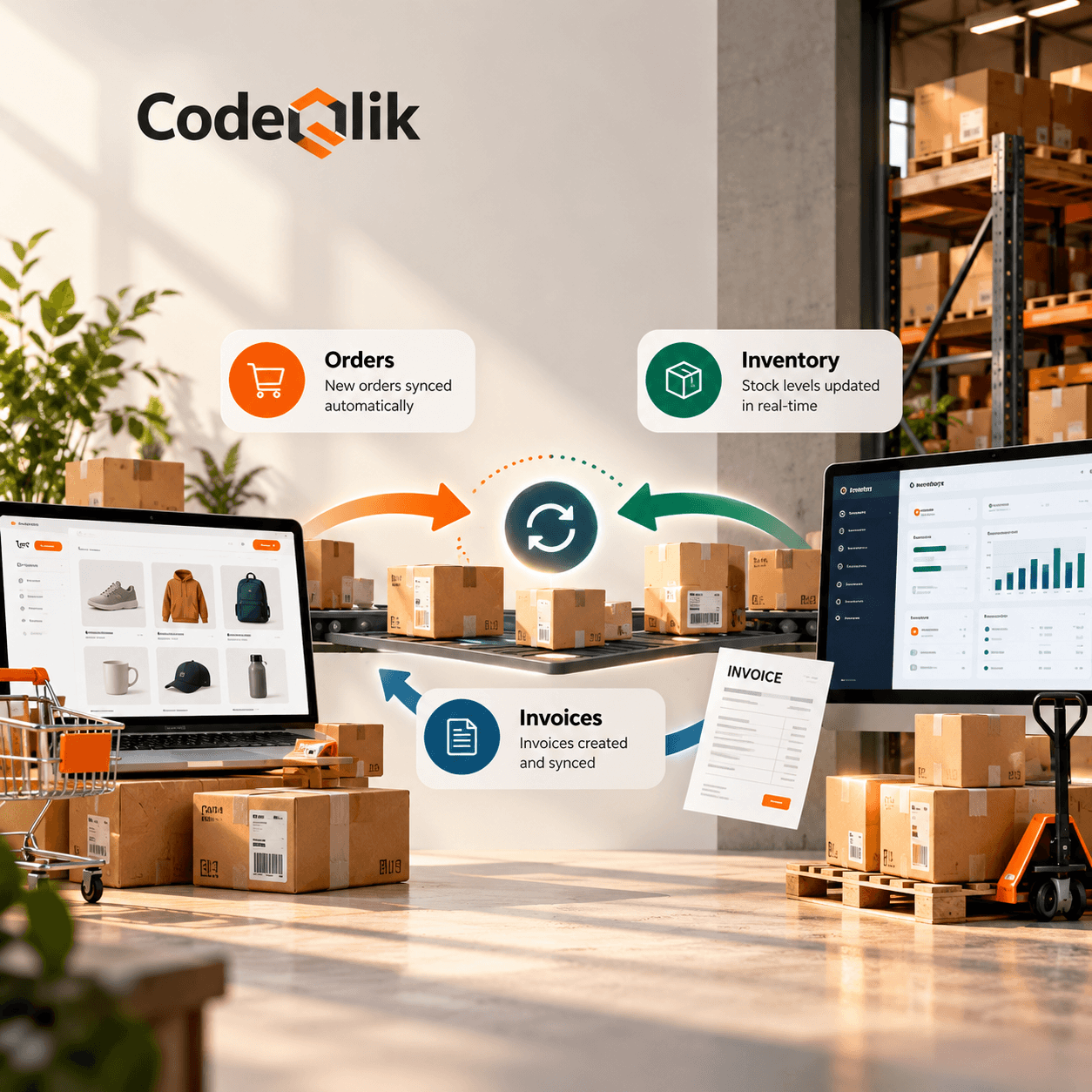
Orders go from Shopify into Odoo. Each one should land as a sales order that has the right customer, items, quantities, taxes, discounts and shipping charges. When the parcel actually leaves the warehouse, status and tracking number flow back to Shopify, and your customer gets that "it's on its way" email.
Stock mostly goes the other direction. Odoo sees the purchases, the receipts, the returns, every box that moves around the warehouse, so inventory belongs there. It tells Shopify how much is sellable, and the shop stops promising things you don't have.
Invoices and payments are Odoo's department. Order confirmed, order delivered, then Odoo makes the invoice and records the payment. Refund something in Shopify and a credit note ought to show up in Odoo without anyone asking.
Under all of it sit products, variants, customers and price lists. Messy there, messy everywhere.
Three ways to wire it up
There's no single right answer here. It depends on your order volume, your budget, and how weird your business rules are.
Quickest start: a ready-made connector. Plenty of third-party apps link Shopify and Odoo and move products, orders, customers and stock from day one. For a standard shop they're hard to beat. Downside? You inherit somebody else's design decisions, and Odoo versions matter a lot, so check that the connector supports yours before paying.
Option two is an integration platform like Make, Zapier or n8n. It sits in the middle and shuffles data around using rules you build yourself. Flexible, and a simple flow doesn't need a developer. But push thousands of orders a day through it, or add some tangled logic, and it gets fiddly and expensive fast.
Option three: custom work on the Shopify Admin API (GraphQL-first these days) and Odoo's external API. It's the priciest way to start. In return you control the mapping, the error handling and every oddity, from bundles to multiple currencies to strange tax rules. I'd skip it unless a connector or platform truly can't do the job.
Orders: don't let one become two
This is where integrations succeed or quietly rot.
Rule number one: store Shopify's order ID in Odoo and look it up before creating anything. Why? Shopify can fire the same webhook twice, and networks stumble now and then. No lookup, and one order becomes two. So does the invoice. It's basic master data hygiene, really: one real thing, one record.
Customers deserve the same care. Match on email or customer ID before creating a contact, or you'll end up with five Sarahs. Decide early what to do about guest checkouts.
Then there's the money. Taxes, shipping, discounts, gift cards: each needs a proper home. Shopify says $107.50, Odoo says $107.49 because of rounding, and yes, your accountant will find that cent. Map every line type deliberately. Then punish it with ugly test orders. A discount code. A partial refund. Two shipping methods. A buyer in another country.
Stock: the oversell problem
Everyone's scared of overselling. Fair. It's almost always a stock-sync issue.
Make Odoo the boss of stock numbers. And push what you can actually sell, not the raw on-hand count, otherwise reserved stock and orders already in progress get counted twice. A lot of teams also hold back a small buffer on fast sellers. A few seconds of lag between systems is normal, so don't pretend it isn't.
More than one warehouse? Then map each Odoo warehouse to its Shopify location, so shoppers see stock from the place that will actually ship. Sell on Amazon or in a physical shop too? Then Shopify isn't your only channel, and Odoo has to count all of them. Otherwise the numbers drift.
And don't lean on real-time pushes alone. Webhooks fail. Not often, but they do. A nightly check that compares both sides and flags mismatches is cheap insurance, and it catches what slipped through.
Invoices, payouts and refunds
Finance starts paying attention here.
Let Odoo create the invoice from the sales order, with Odoo's own numbering. Please don't reuse Shopify order numbers as invoice numbers. Tax authorities generally expect an unbroken sequence, and Shopify's won't be one. Record every payment against the right journal for its gateway and reconciling later gets a lot easier.
Payouts are the sneaky part. A gateway pays you net of fees, often in one batch covering lots of orders, so the bank deposit never matches a single sale. A common fix is to book the fees as their own expense and reconcile each payout against its batch. Sort this out with your accountant before go-live. Not after the first month-end.
Refunds should arrive as credit notes. Test the awkward ones: partial refunds, restocking, refunds on orders you've already invoiced. That's where connectors tend to trip. And if you sell across borders, check how VAT or GST is handled on both sides before launch.
Where it goes wrong
SKUs, mostly. One product, two slightly different SKUs, say a stray hyphen, and the match fails. So does everything built on it. Clean them up before you connect anything.
Bundles and kits bite too, because Shopify and Odoo don't treat them the same way. Then there's testing with five neat orders and launching into two thousand messy ones. Or forgetting API rate limits, so during a big sale the syncs pile up and stock goes stale right when it matters. Or skipping error alerts and finding out three days later. Worst of all, nobody owns the thing, so when it breaks everybody assumes somebody else is on it.
A made-up but realistic example
Picture a small home-goods brand (an invented scenario, not a named client) selling on Shopify, with stock kept in a spreadsheet. A few orders a day? Fine. Then a seasonal sale pushes it to a few hundred, and they sell their bestselling lamp twice over in a single weekend.
So they move stock and accounting into Odoo and hook it up to Shopify with a marketplace connector. Orders land in Odoo within minutes. Available stock goes back to Shopify after every warehouse movement. Invoices get created on their own. For two weeks they keep the old process running alongside, fix a handful of SKU mismatches, and add a nightly check comparing stock on both sides. Next sale: not one oversold item. The tool wasn't the hero. The testing and cleanup were.
Rolling it out
Data first. Standardize your SKUs, tidy up variants, merge the duplicate customers. Then settle who owns what, which is usually Shopify for the storefront and customer details and Odoo for stock, pricing logic and accounting. Pick a route. Build a test setup using a copy of your real products plus a few awkward orders you've actually seen.
Run old and new side by side for a bit and compare the results. Go live one flow at a time (orders, then stock, then invoices) so you can tell what broke. Turn on failed-sync alerts on day one. For the first month, look through the exceptions every week.
What to measure
Keep an eye on a few numbers. How long does an order take to show up in Odoo after checkout? How many sync without anyone touching them? Do the stock figures match on both sides? Count oversells, invoice errors and failed syncs too, plus how long refunds take to reconcile. But the one I'd watch hardest is dull: how long a failure sits there before somebody notices.



Loading comments...