
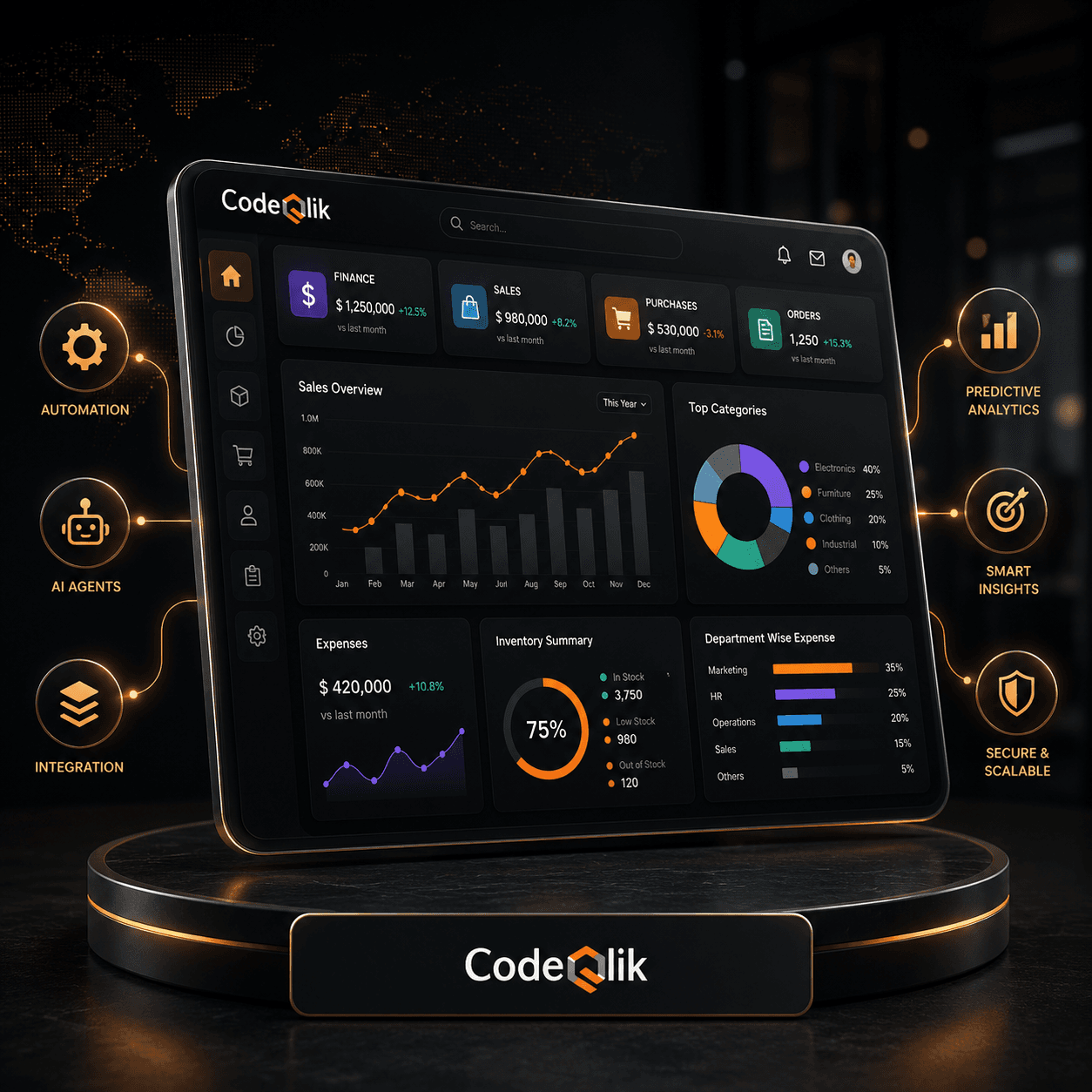
Why 2026 Is a Turning Point for ERP and AI
Several forces are converging at once:
- Maturing generative AI models are now reliable enough for business-critical tasks, not just chatbots.
- Cloud-native ERP platforms have replaced most legacy on-premise systems, giving AI tools the real-time data access they need.
- Rising labor and operating costs are pushing leadership to prioritize automation over headcount growth.
- Competitive pressure is mounting as early adopters report measurable efficiency gains (illustrative estimates suggest double-digit reductions in manual processing time, though actual results vary by organization).
Together, these factors mean 2026 isn't just another incremental software refresh cycle — it's the year AI shifts from "nice to have" to "core infrastructure" inside ERP.
The Evolution of ERP: From Rigid Systems to Intelligent Platforms
Traditional ERP systems were built for record-keeping, not reasoning. They stored data. They didn't interpret it.
The Legacy Era
Early ERP platforms centralized data but required heavy customization, manual reporting, and long implementation cycles. Decisions still depended on human analysts pulling reports and interpreting trends after the fact.
The Cloud Shift
Cloud ERP introduced real-time updates, easier integrations, and mobile access. This laid the groundwork for AI by creating clean, centralized, continuously updated data pipelines — the fuel AI systems need to function well.
The Intelligent ERP Era
Now, intelligent ERP platforms go a step further. They don't just store and display data — they interpret it, predict outcomes, and act on it. This is the foundation of the broader shift toward ERP AI trends 2026, where systems increasingly operate as active collaborators rather than passive repositories.
Key AI Capabilities Driving Change
Several distinct AI technologies are converging inside modern ERP suites. Each brings a different kind of value.
Generative AI
Generative AI powers natural-language report creation, drafts vendor communications, and summarizes complex financial statements into plain language for executives.
Predictive Analytics
Predictive models forecast demand, cash flow, and equipment failures before they happen, shifting ERP from a rearview mirror to a windshield.
Intelligent Automation
Beyond simple rule-based automation, intelligent automation handles exceptions, adapts to new patterns, and reduces the need for constant manual reconfiguration.
Natural Language Processing (NLP)
NLP allows users to query ERP systems conversationally — "show me Q3 shipping delays by region" — instead of navigating multiple menus and filters.
AI Agents
Autonomous AI agents are emerging as the most transformative capability. They can independently execute multi-step tasks, such as reconciling invoices or rerouting a delayed shipment, with minimal human intervention.
Generative AI
- Primary Function: Drafts content, summarizes data
- Business Impact: Faster reporting, reduced admin workload
Predictive Analytics
- Primary Function: Forecasts trends and risks
- Business Impact: Better planning, fewer stockouts or shortfalls
Intelligent Automation
- Primary Function: Automates adaptive workflows
- Business Impact: Lower operational costs, fewer errors
NLP (Natural Language Processing)
- Primary Function: Enables conversational queries
- Business Impact: Faster decisions, broader system accessibility
AI Agents
- Primary Function: Executes autonomous multi-step tasks
- Business Impact: Reduced manual workload, faster response times
This combination is what defines true AI-powered ERP systems in 2026 — not a single feature, but an integrated intelligence layer across the platform.
How AI Is Transforming Core ERP Modules
Finance
AI-driven finance modules now flag anomalies in real time, automate reconciliation, and generate forecasts based on live transaction data rather than month-end snapshots. This significantly shortens the close cycle in many implementations.
Supply Chain Management (SCM)
Predictive models anticipate disruptions — a delayed shipment, a supplier shortage — and recommend alternative routes or vendors before the disruption impacts operations. This is central to ERP automation 2026 initiatives aimed at building resilient, self-correcting supply chains.
Human Resources
AI supports workforce planning by predicting attrition risk, matching internal talent to open roles, and automating onboarding paperwork. HR teams shift from administrative processing to strategic talent management.
Manufacturing
AI-enabled ERP now integrates with IoT sensors on the factory floor to predict equipment failures before downtime occurs, optimize production schedules dynamically, and reduce material waste through smarter demand forecasting.
Real-World Use Cases Across Industries
Retail
A mid-sized retailer could use AI-powered demand forecasting inside its ERP to reduce overstock and understock incidents across seasonal inventory — a scenario increasingly common as retailers integrate predictive analytics with point-of-sale data.
Healthcare
Hospital systems are piloting AI-enhanced ERP modules to forecast supply needs for medical consumables, reducing emergency procurement costs and improving patient care continuity.
Manufacturing
A manufacturer running AI-driven predictive maintenance within its ERP can shift from reactive repairs to scheduled maintenance windows, minimizing unplanned downtime — a pattern reported across multiple industrial AI case studies.
(Note: figures above are illustrative examples based on common industry patterns, not sourced statistics from a specific vendor study.)
Benefits of AI-Powered ERP Systems
- Efficiency: Automating repetitive tasks frees staff for higher-value work.
- Better decision-making: Real-time predictive insights replace guesswork.
- Cost reduction: Fewer manual errors and optimized resource allocation lower operating costs.
- Agility: Businesses can respond to market shifts faster with AI-driven forecasting and automation.
- Scalability: Intelligent systems adapt to growing data volumes without proportional headcount increases.
Challenges to Address Before Adopting AI-Driven ERP
AI adoption isn't plug-and-play. Leaders should plan for these hurdles:
Data Quality
AI models are only as good as the data feeding them. Fragmented, outdated, or inconsistent data undermines predictive accuracy.
Integration Complexity
Many organizations still run a mix of legacy and modern systems. Integrating AI capabilities across this hybrid landscape requires careful planning.
Security and Compliance
AI systems processing sensitive financial and HR data raise new questions around data privacy, access control, and regulatory compliance.
Change Management
Employees need training and clear communication to trust and effectively use AI-driven recommendations rather than ignoring or overriding them.
2026 Outlook: How to Approach AI-Driven ERP Adoption
Organizations planning an ERP upgrade in 2026 should take a phased, deliberate approach:
- Audit your current data quality before layering AI on top of existing systems.
- Start with high-impact, low-risk use cases — such as automated reporting or demand forecasting — before scaling to autonomous agents.
- Involve cross-functional stakeholders early, including finance, IT, and operations leaders.
- Choose vendors with transparent AI governance and clear explainability features.
- Invest in training so teams understand how to work alongside AI-driven recommendations.
- Set measurable KPIs to track ROI on AI-driven ERP automation, rather than adopting AI features for their own sake.
Conclusion
AI in ERP software 2026 marks a genuine shift from passive data systems to active, intelligent business partners. Generative AI, predictive analytics, intelligent automation, NLP, and autonomous agents are converging to reshape finance, supply chain, HR, and manufacturing modules alike.
The organizations that succeed won't be the ones that adopt every AI feature immediately. They'll be the ones that address data quality, plan integrations carefully, and roll out AI-driven ERP automation in deliberate, measurable stages.
The result is a more efficient, agile, and resilient enterprise — one built for the pace of change ahead.
Loading comments...