

What ERP Data Actually Is (and Why AI Wants It)
Before talking about AI, it's worth being honest about what ERP data actually looks like on the inside, because that's where most of the risk and most of the opportunity live.
ERP data analytics draws from records such as:
- Financial data — general ledger entries, accounts payable/receivable, budgets, cost centers
- Supply chain data — purchase orders, supplier lead times, shipment tracking, warehouse stock
- Production data — machine run times, maintenance logs, scrap rates, work orders
- HR and workforce data — headcount, shift schedules, payroll, absenteeism
- Customer and sales data — order history, pricing, returns, fulfillment timelines
What makes this data attractive to AI isn't just the volume — it's the structure. ERP systems are transactional by design, meaning every entry is timestamped, linked to an owner, and connected to other records. A purchase order is tied to a supplier, a cost center, a delivery date, and eventually an invoice. That web of connections is exactly the kind of structured signal machine learning models thrive on.
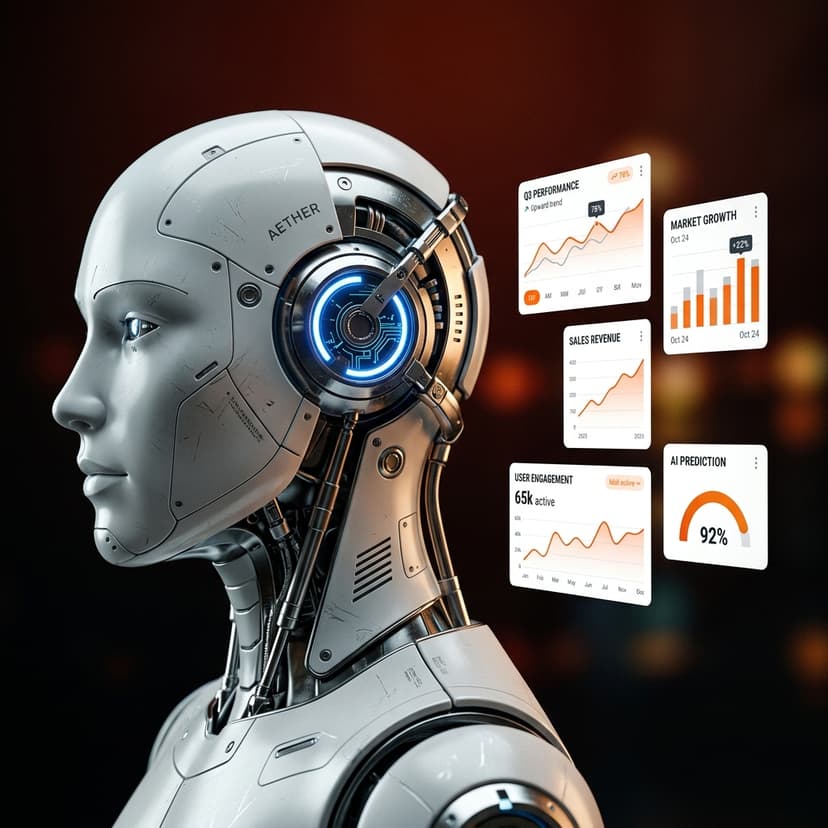
It also explains why interest has exploded so quickly. Traditional business intelligence dashboards show you what happened last quarter. AI in ERP tries to answer a different question: what should happen next, and should the system just go ahead and do it?
How AI Actually Makes Decisions on ERP Data
It helps to demystify this rather than treat it as a black box. Most AI decision-making layered onto ERP systems follows a fairly consistent pattern.
1. Inputs. The model pulls structured data (inventory counts, order histories, sensor feeds) and sometimes unstructured data (supplier emails, maintenance notes, contracts) from the ERP and connected systems.
2. Processing. Depending on the use case, this might be a forecasting model predicting demand, a classification model flagging anomalies, or a recommendation engine suggesting reorder quantities. Some setups use large language models to interpret text-based records; others rely on more traditional statistical or machine learning approaches.
3. Outputs. The system produces a recommendation, an alert, or — in more mature deployments — an automated action, like triggering a purchase order or rescheduling a production run.
4. Human-in-the-loop. This is the piece that separates a responsible deployment from a risky one. In most well-run implementations, AI doesn't get final say on high-stakes decisions. It proposes; a human approves, adjusts, or overrides. Over time, as trust builds and error rates stay low, some lower-risk, high-frequency decisions (like routine reordering of low-cost parts) may be handed over to full automation, while higher-stakes ones (large capital purchases, workforce changes) stay firmly human-approved.
That gradient — from suggestion, to approval-required action, to full autonomy — is really the story of how AI decision-making matures inside any ERP environment. Companies rarely go from zero to full automation. They walk the gradient one use case at a time.
The Benefits: Where This Genuinely Pays Off
It's easy to be cynical about AI hype, but the efficiency gains here are real and measurable when implementations are done carefully.
Efficiency and speed Decisions that used to take a person a day of cross-referencing spreadsheets can happen in minutes. Reorder points, staffing adjustments, and exception flags get surfaced automatically instead of waiting for a weekly report.
Forecasting accuracy AI models can weigh dozens of variables simultaneously — seasonality, supplier reliability, macroeconomic indicators — something a human analyst simply can't do consistently at scale. This is where supply chain optimization sees some of its biggest wins.
Predictive maintenance By analyzing machine performance data already sitting in the ERP, AI can flag equipment likely to fail before it happens, shifting maintenance from reactive to predictive and cutting unplanned downtime.
Measurable KPIs to track ROI of AI ERP initiatives:
- Reduction in inventory carrying costs (%)
- Forecast accuracy improvement (MAPE reduction)
- Unplanned downtime hours avoided
- Time-to-decision for routine operational tasks
- Reduction in manual data reconciliation hours
- Order fulfillment cycle time
Mini case study — mid-sized manufacturer: A regional auto-parts manufacturer layered a predictive maintenance model onto its ERP's equipment logs. Within six months, unplanned downtime dropped by roughly 18%, and the maintenance team shifted from constantly firefighting to scheduling repairs during planned downtime windows. The ROI showed up not just in saved repair costs, but in fewer missed shipment deadlines.
The Risks: What Nobody Puts in the Sales Pitch
This is the part that deserves equal weight, because the failure modes here are quieter and more expensive than people expect.
Data quality problems compound fast. ERP systems accumulate years of inconsistent entry — duplicate vendor records, mismatched units of measure, outdated pricing fields. An AI model doesn't know any of that is wrong; it just learns the pattern, including the bad ones. Garbage in, confident garbage out.
Bias hides in "normal" data. If a company's historical purchasing data reflects a bias toward certain suppliers for reasons unrelated to performance, an AI model trained on that history will happily perpetuate it — just faster and with less visibility into why.
Explainability gaps create real liability. When an AI system denies a supplier payment adjustment or reroutes production, someone eventually has to explain why. If the model can't produce a clear, auditable reason, that's a governance problem and, in regulated industries, potentially a compliance one.
Security exposure grows with connectivity. ERP systems already sit at the center of a company's most sensitive data. Layering AI tools on top — especially ones that call external APIs or use cloud-based models — expands the attack surface and raises new data privacy questions about where information flows and who can see it.
Mini scenario — the reorder that wasn't: Imagine a mid-market retailer's AI reordering tool double-counts inventory across two warehouses due to a stale integration between systems. It confidently halts reorders for a fast-moving SKU, assuming stock is sufficient. Three weeks later, the shelves are empty and a top customer walks. Nothing exotic happened — no rogue algorithm, no dramatic hack. Just an unnoticed data integrity issue that an automated decision acted on without a human sanity check.
That's usually how AI-in-ERP failures actually unfold: not dramatically, but quietly, through a small crack in data lineage or an assumption nobody double-checked.
Governance and Best Practices
None of the above is an argument against adopting AI in ERP — it's an argument for building the guardrails first. A solid data governance approach typically includes:
- Establish data lineage — know where every data point originated, how it's transformed, and who's responsible for it, so errors can be traced quickly.
- Set data quality thresholds — define minimum standards (completeness, accuracy, timeliness) before a dataset is allowed to feed a decision-making model.
- Build a governance framework with clear ownership — assign accountability for model outputs, not just IT infrastructure. Someone needs to own "was this decision right?"
- Require explainability by design — favor models and vendor tools that can articulate why a recommendation was made, especially for high-stakes actions.
- Layer in human-in-the-loop checkpoints — decide upfront which decisions can be fully automated and which always require sign-off.
- Protect data privacy and security — apply access controls and encryption consistent with how sensitive the underlying ERP data is, and vet any third-party AI tool's data handling practices.
- Audit regularly — periodic reviews of model decisions against actual outcomes catch drift before it becomes a costly pattern.
Think of governance not as a brake on innovation, but as the thing that lets you go faster later, because you trust what the system is doing.
Implementation Roadmap: How to Actually Roll This Out
A practical, phased approach beats a big-bang rollout almost every time.
- Assess data readiness. Audit your ERP data for completeness, consistency, and known quality issues before choosing a use case. This step alone often takes longer than expected — and that's fine.
- Pick a narrow, low-risk pilot. Choose one process with clear metrics and low downside if the model gets it wrong — inventory reordering for low-cost items is a common starting point.
- Define human checkpoints upfront. Decide, before launch, which decisions the AI can make alone and which need approval. Write it down.
- Run the pilot with a tight feedback loop. Track accuracy, adoption, and edge cases. Expect to retrain or adjust within the first few months.
- Manage the change, not just the tech. This is where most rollouts actually stall. Involve the people whose jobs touch the process, explain what's changing and why, and give them a way to flag when the AI gets something wrong. Change management succeeds or fails on trust, not technology.
- Scale deliberately. Once a pilot proves reliable, expand to adjacent processes rather than jumping straight to full automation across the enterprise.
- Institutionalize governance. Fold the pilot's lessons into your broader data governance framework so the next use case starts from a stronger position.
Mini case study — phased rollout done right: A distribution company started with AI-assisted demand forecasting for just one product category, kept a planner in the approval loop for every recommendation, and tracked forecast accuracy weekly. After four months of consistent performance, they expanded automation to routine reorders under a set dollar threshold, while keeping larger purchases human-approved. Eighteen months in, forecast error had dropped by double digits, and — just as importantly — the planning team trusted the system enough to stop double-checking every output, freeing them for higher-value analysis work.
Industry Use Cases
- Manufacturing: Predictive maintenance models flag failing equipment using ERP-logged sensor and maintenance data, reducing unplanned downtime.
- Retail and distribution: AI-driven demand forecasting and automated reordering keep shelves stocked while reducing excess inventory carrying costs.
- Healthcare administration: AI flags billing anomalies and supply shortages in hospital ERP systems, supporting both compliance and patient care continuity.
- Logistics and supply chain: Route and supplier optimization models use ERP shipment and lead-time data to reduce delivery delays and freight costs.
- Financial operations: Anomaly detection on ERP-based transaction data helps finance teams catch errors or potential fraud earlier than manual review cycles would.
Conclusion: Key Takeaways and What's Next
So, what happens when AI starts making decisions from your ERP data? In the best implementations, decisions get faster, forecasts get sharper, and teams spend less time reconciling spreadsheets and more time on judgment calls that actually need a human. In the worst ones, small data quality issues get automated at scale, and nobody notices until the damage is visible on the shop floor or the balance sheet.
The difference isn't the sophistication of the AI model. It's almost always governance, data quality, and how deliberately the rollout was managed. Companies that treat this as a change management project as much as a technology project tend to get the results they were promised in the pitch deck. Companies that skip straight to automation tend to learn the hard way why human-in-the-loop checkpoints exist.
If your organization is exploring AI-driven decision-making within your ERP environment, the smartest first move isn't picking a vendor — it's auditing your data and defining where human judgment stays non-negotiable. Get that foundation right, and the rest becomes a lot less risky.
Ready to explore what this could look like for your organization? Reach out for a consultation to assess your ERP data readiness and map a pilot that fits your operations.

Loading comments...